Most of Carmel Valley's oldest, most character-driven neighborhoods date to the 1980s and 90s — Belmont doesn't. Built in the early 2000s as a planned subdivision, it offers buyers a genuinely different proposition than the area's older established tracts: consistent architecture, an HOA that keeps exteriors and landscaping to a shared standard, and a layout designed from the outset for walkability rather than one that grew into it over decades.
Positioned near Carmel Country Road in the heart of the 92130 ZIP code, Belmont keeps both I-5 and Highway 56 within a short drive — enough to make a Del Mar beach trip, a workday in Sorrento Valley, or an evening out in UTC or La Jolla all realistic without a long commute eating into the day.
Belmont's roughly 300 to 350 homes date to a single early-2000s build-out, and the architecture reflects that — styles and lot sizes stay notably consistent from block to block rather than showing the variation typical of an older neighborhood shaped by decades of individual renovation. An HOA keeps exterior maintenance and landscaping to a shared standard across the tract, and the community itself was planned from day one around foot traffic, with walkways, lighting, and small shared green spaces built into the original design rather than layered on afterward. Exact home count and build years should be confirmed against county or MLS records before publishing with specific figures.
Belmont sits within Carmel Valley's broader school corridor, with families typically drawing on a mix of highly rated public elementary and middle school options nearby, along with private and charter alternatives offering specialized academic tracks for buyers who want a particular curriculum emphasis. UC San Diego sits close enough to be a relevant draw for older students or academically-minded families considering the area long-term. District assignment should be verified directly before publishing — some source material references San Diego Unified, which would be inconsistent with the Del Mar Union/San Dieguito Union pairing used elsewhere in Carmel Valley and needs confirmation.
Belmont's green space is scaled for everyday routine rather than weekend outings — think a short loop before dinner or a nearby playground after school, not a park worth planning a trip around. That's a deliberate trade-off: residents give up the scale of a large regional park in exchange for not having to drive anywhere to use what's there.
Carmel Mountain Plaza and Del Mar Highlands Town Center both sit within a short drive, covering grocery, cafes, restaurants, and everyday services. Del Mar Highlands in particular has grown into a genuine dining destination over the years, with a broad mix of restaurant concepts alongside its retail and grocery anchors.
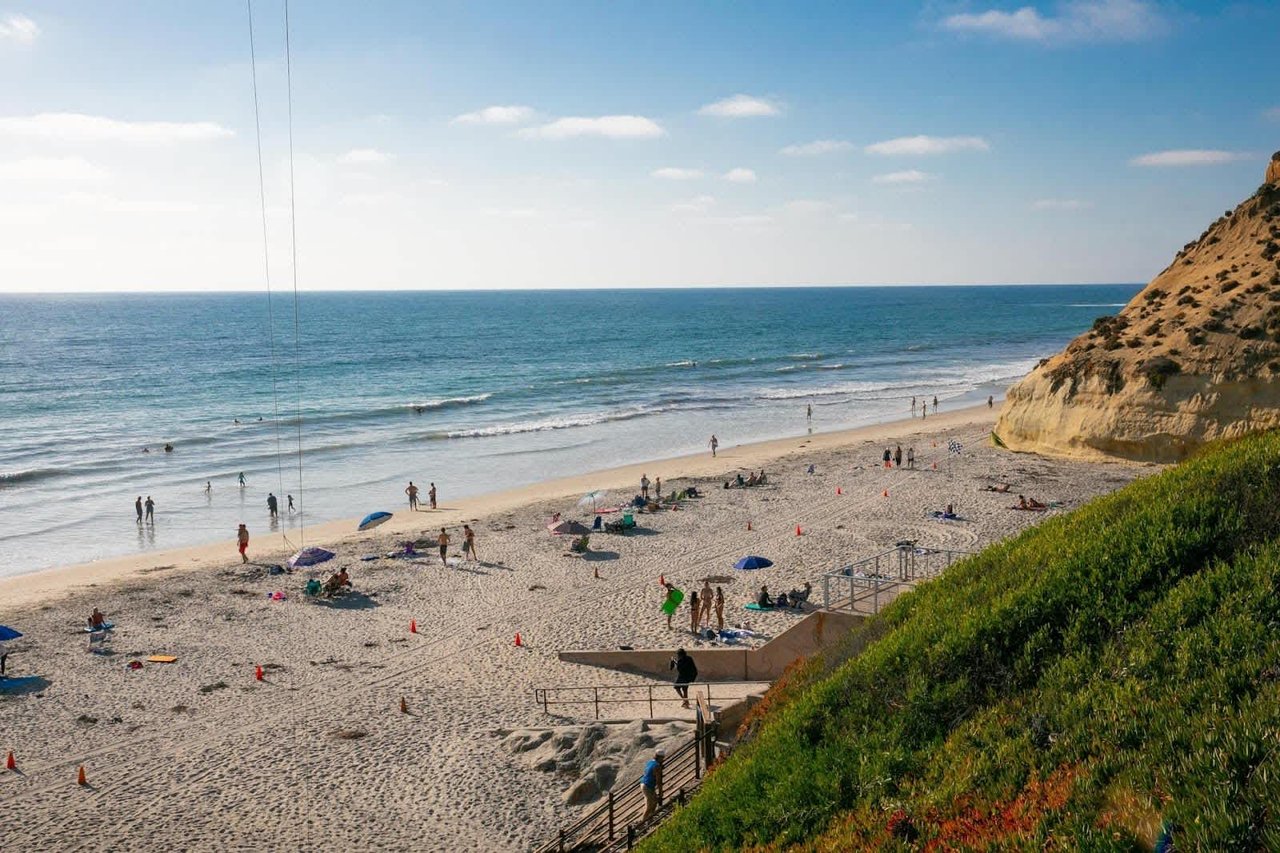
Torrey Pines State Reserve gives residents a hiking and bluff-top-views option within a reasonable drive, and the beach and surf breaks below it are reachable heading west in well under half an hour. Golf courses and organized sports fields round out the recreation picture, sitting roughly the same distance away but in the opposite direction, toward the east and north of the neighborhood.
Both I-5 and Highway 56 sit within a short, reliable drive, though timing shifts with the time of day. Neighborhood streets connect quickly to the main commercial corridors, and public bus service passes through the immediate area for residents who'd rather not drive. As with most of Carmel Valley, mornings and late afternoons bring the heaviest traffic on the routes running north and south, so it's worth building in extra time around school drop-off hours.
Compared to Carmel Valley's older, established neighborhoods — communities built in the 1980s and 90s with decades of individual renovation history — Belmont offers a more uniform, move-in-ready feel from a single planned build-out. That consistency appeals to buyers who want predictability in architecture and street appearance; it's a different trade-off than the character and renovation-driven variety found in the area's earlier tracts.
Community type: Master-planned single-family subdivision, built early 2000s
HOA status: Active HOA enforcing shared landscaping and exterior maintenance standards
Location: Near Carmel Country Road, 92130 ZIP code
Schools: Mix of public, private, and charter options nearby; district assignment needs verification
Standout feature: Architectural and streetscape consistency from a single planned development, versus the mixed character of Carmel Valley's older tracts
Best fit for: Buyers who prioritize uniformity, HOA-managed upkeep, and a newer build over the individual character of Carmel Valley's established 1980s–90s neighborhoods
Belmont: Newer (early 2000s) planned subdivision, active HOA, consistent architecture, family-oriented pocket parks
Pacific Highlands Ranch: Newer construction with modern floor plans and HOA-managed trails and parks, generally larger-scale than Belmont
Torrey Hills / Torrey Del Mar: Smaller-lot townhomes and condos, lower-maintenance alternative to single-family living
Bayshore: Established 1986 community, no Mello-Roos, more individual character and walkability to The Bay Club
Amador: No HOA at all, larger lots, no Mello-Roos — the opposite trade-off from Belmont's managed, uniform approach
Ashley Falls: Multiple older subdivisions sharing one school boundary, HOA status varies by pocket
As a smaller, cohesive planned community, Belmont tends to see steady demand from buyers who specifically want newer construction and HOA-managed consistency rather than the renovation variability found in Carmel Valley's older tracts. Because architectural styles and lot sizes are more uniform across the neighborhood than in older, more individually renovated communities nearby, condition and lot positioning tend to matter less to pricing here than they do elsewhere in Carmel Valley — location within the subdivision and proximity to the shared green spaces carry more weight.
How old are the homes in Belmont? Belmont was built as a planned subdivision in the early 2000s, making it newer than many of Carmel Valley's established 1980s and 90s neighborhoods.
Does Belmont have an HOA? Yes. An active HOA enforces shared landscaping and exterior maintenance standards across the community — a different approach than no-HOA neighborhoods like Amador nearby.
What schools serve Belmont? Families typically draw on a mix of public, private, and charter options in the broader Carmel Valley school corridor. Exact district assignment should be confirmed directly, as available source material is inconsistent on this point.
How does Belmont compare to Carmel Valley's older neighborhoods? Belmont offers more architectural and streetscape consistency from a single planned build-out, versus the individual character and renovation variety found in communities like Bayshore or Alta Mar that were built decades earlier and updated piecemeal by successive owners.
What's nearby for shopping and outdoor recreation? Carmel Mountain Plaza and Del Mar Highlands Town Center cover everyday shopping and dining within a short drive, while Torrey Pines State Beach and coastal trails are within an easy drive west.